From singing at concerts to singing 'Happy birthday'.
从在音乐会上唱歌到唱‘生日快乐’歌。
Around the world, humans have been singing in unison for millennia.
在世界各地,人类齐声歌唱已有数千年之久。
Some anthropologists even think our ancestors may have sung before they could speak.
一些人类学家甚至认为,我们的祖先在会说话之前可能就会唱歌。
"Lullabies are sung to children, and then songs are sung at funerals", says Alex Street, from the Cambridge Institute for Music Therapy Research, who thinks that our positive response to music is no accident.
来自剑桥音乐治疗研究所的亚历克斯·斯特里特说:‘人们会给儿童唱摇篮曲,在葬礼上唱歌。’他认为我们对音乐的积极反应并非偶然。
Music is not only enjoyable, but beneficial for our health.
音乐不仅令人愉悦,而且有益于我们的健康。
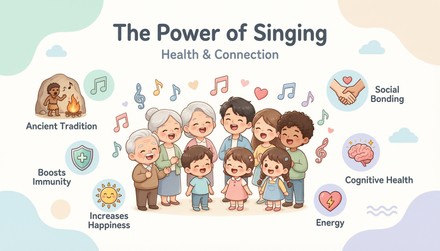
There is growing evidence that singing can energise us, improve immune function and increase feelings of happiness, according to 'A Review of the Physiological Effects and Mechanisms of Singing', published in 2018.
根据2018年发表的《歌唱的生理效应和机制综述》,越来越多的证据表明,唱歌能让我们充满活力、改善免疫功能并增加幸福感。
It's thought that the repeated and controlled breathing that singing requires releases endorphins, which are chemicals released by the brain associated with pleasure and wellbeing.
人们认为,唱歌所需的重复且受控的呼吸会释放内啡肽,这是一种大脑释放的与快乐和健康相关的化学物质。
It may even provide a physical workout comparable to a brisk walk.
它甚至可能提供相当于快走的身体锻炼。
And singing as part of a group or choir may have additional effects.
作为团体或合唱团的一部分唱歌可能还有额外效果。
Researchers in 'The ice-breaker effect: singing mediates fast social bonding' found that singing together accelerated faster social cohesion among strangers.
《破冰效应:唱歌促进快速社会联结》的研究人员发现,一起唱歌能加速陌生人之间更快地建立社会凝聚力。
Some studies have also found that regular musical activity can help to delay the onset of various neurological conditions such as Parkinson's disease and dementia.
一些研究还发现,定期的音乐活动有助于延缓各种神经系统疾病(如帕金森病和痴呆症)的发作。
And it's not too late for those already living with such conditions.
对于那些已经患有这些疾病的人来说,现在也不晚。
Cathy McGlynn is a music therapist based in Ireland who leads a choir of people with Parkinson's.
凯西·麦格林是爱尔兰的一名音乐治疗师,她带领一个由帕金森患者组成的合唱团。
The disease can lead to respiratory and vocal problems, both of which are benefited by singing practice.
这种疾病会导致呼吸和声音问题,而歌唱练习对这两者都有好处。
For those suffering with dementia, singing can enhance the type of memory which helps us recall names and specific personal experiences, according to a literature review on singing and cognitive health called 'A Song for the Mind'.
根据一篇关于歌唱与认知健康的文献综述《心灵之歌》,对于痴呆症患者,唱歌可以增强帮助我们回忆名字和特定个人经历的记忆类型。
Music therapist Grace Meadows watched as a woman with dementia got up out of her chair and started dancing at a musical performance.
音乐治疗师格蕾丝·梅多斯看到,一位患有痴呆症的女士在音乐表演中从椅子上站起来开始跳舞。
"It was the first time the carers had ever seen her move, unaided."
“这是护理人员第一次看到她无辅助地移动。”
Music may not be a medicine in the traditional sense, but one thing seems clear: humans are wired for connection, and music helps to create it.
音乐可能不是传统意义上的药物,但有一件事似乎很清楚:人类天生渴望建立联系,而音乐有助于建立这种联系。
So, if you're sceptical about the power of music, it may be time to change your tune.
所以,如果你对音乐的力量持怀疑态度,也许是时候改变你的看法了。