Close your eyes and think about the future.
闭上眼睛,思考一下未来。
Do you imagine it to be in front of you or behind you?
你想象它是在你前面还是后面?
Maybe your timeline is vertical, with the future below, and the past above?
也许你的时间线是垂直的,未来在下面,而过去在上面?
Linguists such as Lera Boroditsky believe that the language you speak might influence your perception of time.
像莉拉·博罗迪茨基这样的语言学家认为,你所说的语言可能会影响你对时间的感知。
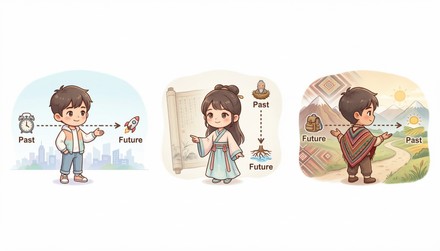
She highlighted that in English, we see time on a horizontal line.
她强调,在英语中,我们将时间视为一条水平线。
The past is behind us, and the future is ahead.
过去在我们身后,未来在我们前面。
We can see this in phrases like 'forward thinking', and 'ahead of schedule' that we use for the future, and 'back in the day' and 'behind the times' for the past.
这可以从我们用于未来的‘前瞻性思维’和‘提前完成’等短语,以及用于过去的‘昔日’和‘过时’中看出。
However, not all languages reflect this perspective.
然而,并非所有语言都反映这种观点。
For the Aymara people in the Andes mountains, the word for future means 'behind time'.
对于安第斯山脉的艾马拉人来说,表示未来的词意为‘时间后面’。
Work by Nuñez and Sweetser revealed that when gesturing, the Aymara people point backwards when talking about the future, while English speakers gesture forwards.
努涅斯和斯威策的研究揭示,在打手势时,艾马拉人谈论未来时指向后方,而英语使用者则向前比划。
It has also been suggested that if you speak Chinese, you might see the timeline more vertically due to the use of 'down' to talk about future events, and 'up' for past events.
还有一种观点认为,如果你说中文,由于用‘下’来谈论未来事件,‘上’来谈论过去事件,你可能会更垂直地看待时间线。
What happens if you speak two languages?
如果你说两种语言会发生什么?
In a study called 'Can a mind have two time lines?'
在一项名为‘一个大脑能有两条时间线?’的研究中,英汉双语者被要求按年龄时间顺序摆放演员的照片。
English-Chinese bilinguals were asked to place photos of actors in chronological order by age.
有趣的是,他们选择将说英语的演员照片水平排列,而将说中文的演员照片垂直排列。
Interestingly, they chose to put photos of an English-speaking actor in a horizontal sequence, but photos of a Chinese-speaking actor in a vertical sequence.
因此,似乎一个人可以有多种时间感知,你的时间线可以根据焦点语言的不同而旋转。
So, it seems like one person can have multiple time perceptions, and that your timeline can rotate depending on which language is in focus.
关于语言在多大程度上塑造了我们的思想和感知的辩论仍在进行。
The debate about how much language shapes our thoughts and perceptions is ongoing.
它已经吸引了语言学家数十年,并将继续引发关注。
It has intrigued linguists for decades and will for ages to come.
因此,下次你规划一天或讲故事时,注意你是如何可视化事件时间线的,并记住不是每个人都通过相同的透镜看待时间!
So, next time you plan your day or tell a story, notice how you visualise the timeline of events, and remember that not everyone sees time through the same lens!