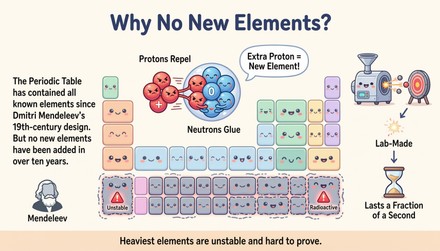
The periodic table contains all known chemical elements.
元素周期表包含了所有已知的化学元素。
It's been expanding ever since chemists like Dmitri Mendeleev first drew it up in the 19th century.
自19世纪德米特里·门捷列夫等化学家首次绘制出元素周期表以来,它一直在不断扩大。
But more than ten years have passed since the last elements were added.
但距离上一次添加新元素已经过去十多年了。
So, why have no new ones been discovered since?
那么,为什么一直没有发现新元素呢?
An element is made of atoms.
元素由原子构成。
At the centre of an atom is a nucleus containing protons and neutrons.
原子中心是原子核,含有质子和中子。
Positively-charged protons naturally repel each other, but they're glued together by uncharged neutrons.
带正电的质子天然相互排斥,但它们被不带电的中子粘合在一起。
Each new member of the periodic table has one extra proton.
元素周期表的每个新成员都多一个质子。
And, if there's not enough neutrons, it could all fall apart.
而且,如果没有足够的中子,整个原子可能会分裂。
The heaviest elements in the periodic table are radioactive and unstable.
元素周期表中质量最大的元素具有放射性和不稳定性。
They have to be made in labs with expensive, cutting-edge tech, and they might only last for a fraction of a second.
它们必须用昂贵的尖端技术在实验室中制造,并且可能只持续几分之一秒。
So, even if a scientist can make one, proving it existed is another battle.
因此,即使科学家能够制造出一个新元素,证明它的存在也是一场新的挑战。