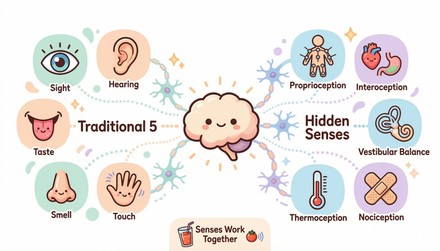
Many of us grew up learning that humans have five senses: sight, hearing, taste, smell and touch – an idea dating back to the Ancient Greek philosopher Aristotle.
我们许多人从小就学习人类有五种感官:视觉、听觉、味觉、嗅觉和触觉——这一概念可以追溯到古希腊哲学家亚里士多德。
But what if this list is incomplete?
但如果这个列表不完整呢?
A sense is anything that can give your body information about the outside world, and some of these don't neatly fit into the traditional five.
感官是任何能给身体提供外部世界信息的东西,其中一些并不完全符合传统的五种。
Modern scientists estimate there may be up to 33 different senses.
现代科学家估计可能有多达33种不同的感官。
One sense that doesn't fit into one of the five boxes is proprioception.
一种不符合这五类感官的是本体感觉。
This is the sense of where your body parts are in space.
这是感知身体部位在空间中的位置的感觉。
Thanks to this sense, you can touch your nose with your eyes closed and walk around in the dark – you know where your legs are without looking.
多亏了这种感觉,你可以闭着眼睛摸到鼻子,在黑暗中行走——不用看就知道腿在哪里。
Then there's interoception which helps you sense things inside your body, like hunger and an increased heart rate.
然后是内感受,它帮助你感知体内的状态,比如饥饿和心率加快。
And don't take your sense of balance for granted.
不要将你的平衡感视为理所当然。
Balance relies on fluid in your inner ear to help you stay upright – this is what's called vestibular perception.
平衡依赖于内耳中的液体来帮助你保持直立——这就是所谓的前庭感知。
And the traditional five senses might not be as simple as they seem.
传统的五种感官可能并不像看起来那么简单。
Touch, the sense we associate with our hands and tactile sensations, also encompasses the sensation of pain, temperature and itch.
触觉,我们与手和触觉联系的感觉,也包括疼痛、温度和痒的感觉。
To perceive the flavours in food and drink, you need a combination of taste, smell and touch to get the full experience – it's not all about the taste buds on your tongue!
要感知食物和饮料中的风味,你需要结合味觉、嗅觉和触觉来获得完整的体验——这不仅仅关乎舌头上的味蕾!
It is actually smell that contributes most of what we perceive as taste, so when a person suffers olfactory loss, they often can't enjoy food as much, according to a 2022 study published in Foods by Fjaeldstad and Smith.
根据Fjaeldstad和Smith在2022年发表在《Foods》杂志上的一项研究,实际上嗅觉贡献了我们感知到的大部分味道,所以当一个人失去嗅觉时,他们通常不能像以前那样享受食物。
Until recently, philosophers and scientists have studied each of the traditional five senses in isolation, but researchers at the University of London's Centre for the Study of the Senses have more of a multisensory approach – the senses are all working together to create an overall picture.
直到最近,哲学家和科学家还孤立地研究传统的五种感官,但伦敦大学感官研究中心的研究人员采用了更多多感官方法——感官都在协同工作以形成整体画面。
In their 'Rethinking the Senses' project, they found that our perception of salt, sweet and sour flavours is reduced when there is white noise, but our perception of umami is not.
在他们的“重新思考感官”项目中,他们发现当有白噪音时,我们对咸、甜和酸味的感知会减弱,但对鲜味的感知不会。
This means that sound can enhance flavour, and that umami-rich foods like tomato juice might taste better on a plane.
这意味着声音可以增强风味,像番茄汁这样富含鲜味的食物在飞机上可能味道更好。
So, perhaps humans are far more sensory creatures than Aristotle ever imagined.
所以,或许人类是比亚里士多德想象的感官更为复杂的生物。
From balance and body awareness to the way sound can change flavour, our senses are constantly working together in ways we rarely notice.
从平衡和身体意识到声音如何改变风味,我们的感官不断地以我们很少注意的方式协同工作。