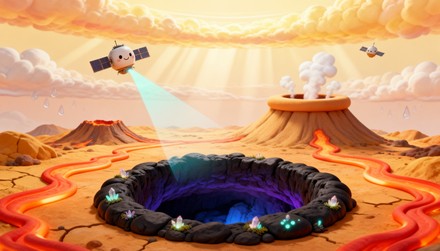
For years, astronomers have hypothesised about life beyond Earth, especially on the closest planet to Earth – Venus.
多年来,天文学家一直推测地球之外存在生命,尤其是离地球最近的行星——金星。
Venus is often named the Earth's 'evil twin' because of its extremely hot temperature and greenhouse effect, which make it toxic and inhospitable.
金星常被称为地球的“邪恶双胞胎”,因为它极高的温度和温室效应使其有毒且不适宜居住。
It is also similar in size, mass and rocky composition.
它在大小、质量和岩石构成方面也很相似。
Though no organic molecules have been discovered on Venus, new findings from the Synthetic Aperture Radar (SAR) instrument on board NASA's Magellan spacecraft shows caves lurking beneath the surface.
尽管在金星上尚未发现有机分子,但美国宇航局麦哲伦号航天器上的合成孔径雷达(SAR)仪器的新发现显示,地表下潜伏着洞穴。
Researchers from Nature Communications add that these could offer us new ideas about the evolution of Venus – about how it might have possibly supported life in the past or could again in the future.
《自然通讯》的研究人员补充说,这些可能为我们提供关于金星演化的新思路——关于它过去如何可能支持生命或未来再次支持生命。
The caves suggest that lava tubes, otherwise known as pyroducts, could be prevalent.
这些洞穴表明,熔岩管(也称为火成管道)可能很普遍。
The search for pyroducts was challenging at first because the planet is shrouded in thick clouds of sulphur and carbon dioxide that not only contribute to the immense temperature but also block any view of the surface.
寻找火成管道起初很具挑战性,因为该行星被厚厚的硫和二氧化碳云层笼罩,这不仅导致极高的温度,还阻挡了地表的任何视线。
However, the recent radar images suggest that a big pyroduct lies near Nyx Mons, a large volcano in the highlands of Venus's Bell Regio region.
然而,最近的雷达图像表明,一个大型火成管道位于尼克斯山附近,这是金星贝尔雷焦地区高地的一座大型火山。
In a 2026 study called 'Radar-based observation of a lava tube on Venus', it can be understood that, in the field of geoscience, volcanoes play an important role in the evolution of a planet.
在一项名为《基于雷达观测的金星熔岩管》的2026年研究中,可以理解到,在地球科学领域,火山在行星演化中扮演重要角色。
If we think about Earth billions of years ago, volcanoes released gases that helped form our oceans and our atmosphere.
如果我们回想数十亿年前的地球,火山释放的气体有助于形成我们的海洋和大气。
Volcanoes keep Earth warm, wet and habitable.
火山使地球保持温暖、湿润和适宜居住。
So, we have evidence that there are many active volcanoes on Venus, but will we ever be able to live there?
因此,我们有证据表明金星上有很多活火山,但我们是否能够在那里生活呢?
Well, we would require an abundance of water, which is greatly lacking on Venus.
嗯,我们需要大量的水,而这在金星上非常缺乏。
But data gathered by the Venus Express orbiter, launched in 2005 by The European Space Agency, could hint toward the planet once having oceans.
但欧洲航天局于2005年发射的金星快车轨道器收集的数据可能暗示该行星曾经拥有海洋。
And though the clouds on Venus rain sulphuric acid, they could still support an exotic biochemistry that thrives in such conditions.
尽管金星的云层降下硫酸雨,但它们仍可能支持在这种条件下繁衍生息的奇特生物化学。
There's also plenty of sunlight to serve as a power source for life.
还有充足的阳光可以作为生命的能源。