Would you like to speak with a British accent?
你想学说英国口音吗?
What if I told you that there is no singular 'British' accent?
如果我告诉你英国口音并不是单一的,你会怎么想?
In fact, linguists estimate that there are 40-60 regional accents across the UK, some of which exist very close together geographically.
事实上,语言学家估计英国有40到60种地区口音,其中一些在地理位置上非常接近。
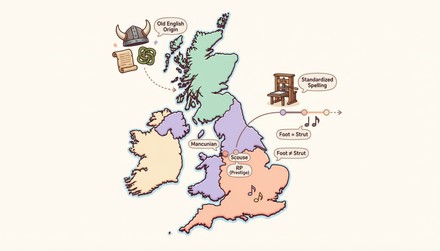
For instance, you can listen to Manchester's 'Mancunian' accent and then Liverpool's distinct 'Scouse' accent after just a 50-minute car or train ride.
例如,你可以在短短50分钟的车程或火车旅程中听到曼彻斯特的“曼彻斯特口音”和利物浦独特的“利物浦口音”。
Some southern English accents, such as 'Received Pronunciation', are associated with social prestige, but can the south claim to have the oldest English accent?
一些南部英语口音,如“标准发音”,与社会声望相关,但南部能声称拥有最古老的英语口音吗?
Or does another UK region take the title?
还是英国另一个地区能夺得这个头衔?
The story is messier than you might expect.
这个故事比你可能预期的要复杂。
The first version of English, Old English, originated in the 5th and 6th centuries when tribes from northern Germany arrived in east England, a region now called 'East Anglia'.
英语的第一个版本,古英语,起源于5世纪和6世纪,当时来自德国北部的部落到达了英格兰东部,即现在称为“东英吉利”的地区。
Their Germanic languages mixed with existing Latin and Celtic languages and became Old English.
他们的日耳曼语与现有的拉丁语和凯尔特语混合,形成了古英语。
It makes sense to think of East Anglia as being the source of the earliest variety of English as we know it, says Kerri-Ann Butcher, a lecturer in English Language at the University of Leeds.
利兹大学英语语言讲师Kerri-Ann Butcher说,将东英吉利视为我们所知的最早英语变体的来源是合理的。
Over the next few centuries, English absorbed many other languages arriving from places like the Netherlands and Scandinavia.
在接下来的几个世纪里,英语吸收了来自荷兰和斯堪的纳维亚等地许多其他语言。
The associated linguistic changes did not happen in an orderly way across the country.
相关的语言变化并未在全国范围内有序发生。
With all these different influences, the English language became messy and inconsistent.
由于所有这些不同的影响,英语变得混乱且不一致。
But in 1476, some spelling norms became standardised with the arrival of the printing press.
但在1476年,随着印刷机的到来,一些拼写规范得以标准化。
Nowadays, the words 'blood', 'food' and 'good', which all contain two letter Os, sound different, but back then, they might have rhymed.
如今,包含两个字母O的单词如'blood'、'food'和'good'发音不同,但当时它们可能押韵。
Between the 12th and 18th centuries, something known as the Great Vowel Shift happened, where some vowel sounds across the country changed.
在12世纪到18世纪之间,发生了所谓的“元音大推移”,全国一些元音发生了变化。
For example, the vowel sound in 'foot' and 'strut' used to be pronounced the same, but then people in the south began pronouncing 'strut' differently.
例如,'foot'和'strut'中的元音曾经发音相同,但后来南部的人开始以不同的方式发音'strut'。
Danielle Turton, sociolinguist at Lancaster University, says the northern pronunciation is absolutely the original one.
兰卡斯特大学的社会语言学家Danielle Turton说,北方的发音绝对是原始的。
It was the south that branched off and created this new vowel.
是南方分支出来并创造了这个新元音。
While East Anglia may have been the home of the earliest English sounds, it did not stick to the original pronunciations like accents in northern England did.
虽然东英吉利可能是最早英语发音的发源地,但它没有像英格兰北部的口音那样坚持原始发音。
And while many think Received Pronunciation is an older-sounding English, in fact, it didn't exist until the 18th century.
虽然许多人认为标准发音听起来更古老,但事实上,它直到18世纪才出现。
The north of England wins!
英格兰北部获胜!