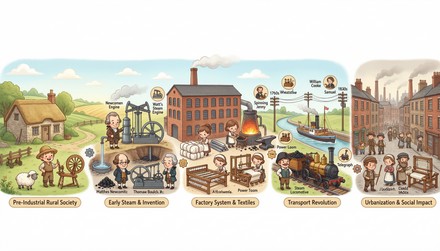
The Industrial Revolution began in Britain in the mid-1700s and spread to other parts of the world, including the United States, by the 1830s and 1840s.
工业革命始于18世纪中叶的英国,并在19世纪30年代和40年代传播到世界其他地区,包括美国。
During this period, Britain transformed from a rural, agrarian society into an industrial and urban one.
在此期间,英国从一个农村、农业社会转变为一个工业和城市社会。
Handcrafted goods were increasingly replaced by machine-made products produced in factories, driven by steam power and new manufacturing techniques, especially in textiles and iron production.
手工制品逐渐被工厂生产的机器制品所取代,这些制品由蒸汽动力和新的制造技术驱动,特别是在纺织和钢铁生产中。
Its foundations can be traced to the early 1700s, when Thomas Newcomen invented the first modern steam engine to pump water from mines.
其基础可以追溯到18世纪初,当时托马斯·纽科门发明了第一台现代蒸汽机,用于从矿井中抽水。
In the 1760s, James Watt improved Newcomen’s design, making it more efficient.
在18世纪60年代,詹姆斯·瓦特改进了纽科门的设计,使其更加高效。
Working with Matthew Boulton, Watt later developed a steam engine capable of producing rotary motion, allowing steam power to be widely applied across industries.
瓦特后来与马修·博尔顿合作,开发了一种能够产生旋转运动的蒸汽机,使蒸汽动力得以广泛应用于各个行业。
Coal became a vital and inexpensive energy source, powering factories and transportation.
煤炭成为一种重要且廉价的能源,为工厂和运输提供动力。
In the early 1800s, Richard Trevithick built a steam-powered locomotive, and by 1830 railways were transporting goods and passengers between industrial cities such as Manchester and Liverpool.
在19世纪初,理查德·特里维西克建造了一台蒸汽动力机车,到1830年,铁路在曼彻斯特和利物浦等工业城市之间运输货物和乘客。
Steam-powered boats and ships were also widely used on canals and across the Atlantic.
蒸汽动力船也在运河和大西洋上广泛使用。
Textile production, once a cottage industry carried out in homes and small workshops, was transformed by inventions such as the spinning jenny and the power loom.
纺织生产曾经是在家庭和小作坊中进行的家庭手工业,但通过发明如珍妮纺纱机和动力织布机而发生了转变。
These machines reduced the need for labour and allowed mechanised factories to meet growing domestic and international demand.
这些机器减少了对劳动力的需求,并使机械化工厂能够满足日益增长的国内和国际需求。
The iron industry also changed significantly with the introduction of coke-smelting instead of charcoal.
钢铁行业也随着引入焦炭冶炼而不是木炭而发生了显著变化。
This cheaper method produced higher-quality metal and enabled expansion, particularly during the Napoleonic Wars and the growth of railways after the 1830s.
这种更便宜的方法生产出更高质量的金属,并促进了扩张,特别是在拿破仑战争期间和19世纪30年代后铁路的发展中。
Advances in communication followed industrial growth.
通信的进步紧随工业增长而来。
In 1837, William Cooke and Charles Wheatstone patented the first commercial telegraph system, which was soon used for railway signalling.
1837年,威廉·库克和查尔斯·惠斯通获得了第一个商业电报系统的专利,该系统很快被用于铁路信号。
At the same time, Samuel Morse and others developed similar systems in the United States, helping improve long-distance communication and railway safety.
与此同时,塞缪尔·莫尔斯等人在美国开发了类似的系统,帮助改善了长途通信和铁路安全。
Industrialisation had a profound impact on daily life.
工业化对日常生活产生了深远的影响。
Rapid urbanisation led to overcrowded cities with pollution and poor sanitation.
快速的城市化导致城市过度拥挤,污染严重,卫生条件差。
While economic output increased and living standards improved for the middle and upper classes, many workers endured long hours, low wages, and dangerous factory conditions.
尽管经济产出增加,中上层阶级的生活水平提高,但许多工人忍受着长时间的工作、低工资和危险的工厂条件。
These hardships led to resistance, most notably from the Luddites, skilled textile workers who opposed mechanised looms that threatened their livelihoods.
这些困难导致了抵抗,最著名的是卢德派,他们是熟练的纺织工人,反对威胁他们生计的机械化织布机。
Beginning in Nottingham in 1811, they attacked factories and destroyed machines.
从1811年在诺丁汉开始,他们袭击工厂并破坏机器。
The government responded harshly, making machine-breaking a capital crime.
政府严厉回应,将破坏机器定为死罪。
By 1813, after executions and deportations, the Luddite movement had largely disappeared.
到1813年,经过处决和流放,卢德派运动已基本消失。